Landlords of the Imagination: We Don't Rewatch Shows, We Visit Them
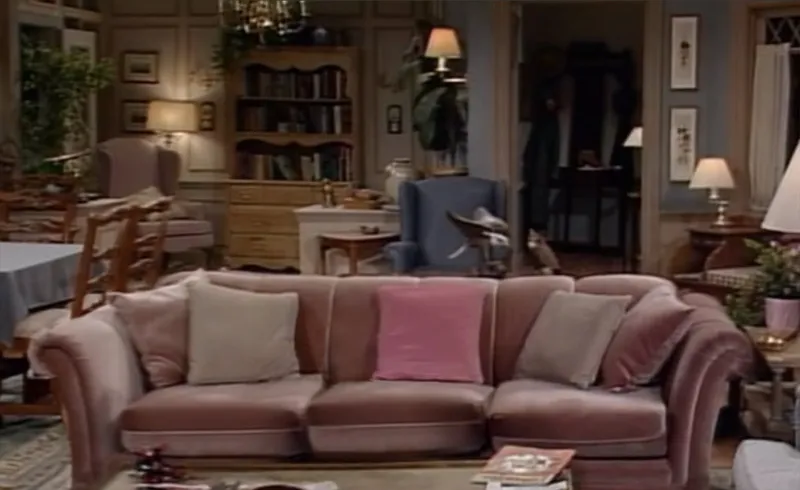
Photo: cozy 90s sitcom style living room apartment set with couch and warm lighting, via i.pinimg.com
There's a moment in almost every long-running sitcom where the camera lingers on an empty set. No dialogue, no joke landing, just the room — the purple walls, the couch, the window with the impossibly good view of the Manhattan skyline. The show is asking you to look at the space itself, and you do, because by season four you know that room better than you know your own living room.
That's not an accident. That's architecture doing narrative work.
The Rent Is Fictional, the Attachment Is Real
Start with the obvious example: the Friends apartment. Monica's place is a two-bedroom in Greenwich Village with a balcony, a bay window, and enough square footage to host a Thanksgiving dinner for eight. In 1990s Manhattan. On a chef's salary. Economically, it's a fantasy — but emotionally, it's a blueprint. Fans have reverse-engineered the floor plan. There are interactive 3D tours online. People have recreated the kitchen in their actual homes, down to the yellow frame around the peephole.
You don't recreate a set because of the writing. You recreate it because you've moved in.
That's the thing we don't say out loud about rewatch culture: half the time we're not rewatching a show, we're revisiting a place. The plot beats are furniture at this point — we could walk through them blindfolded. What we want is the feeling of the room. The warm light of the Gilmore Girls kitchen, always mid-coffee, always smelling faintly of Pop-Tarts. The Stranger Things basement, wood-paneled and safe, where the worst thing that can happen is losing a D&D campaign.
Production Design Is the Unsung Screenwriter
Here's an uncomfortable truth for people who like to credit showrunners with everything: the set often tells you more than the script does. Good production design is exposition you don't notice receiving.
Think about Frasier's apartment. The Eames-style chair, the Cordoba on the terrace, the view of the Space Needle — before anyone says a word, you know exactly who this man thinks he is. The set is a punchline, a character study, and a running gag all at once. Or consider the Golden Girls' kitchen in Miami: that table is the emotional center of the entire series. More friendships were repaired at that lanai table than in any therapist's office on television.
The best sets function like a second narrator. They tell you who's thriving and who's struggling without a single line of dialogue. When a character's space gets messier across seasons, that's character development. When the lighting warms up, that's a tonal thesis statement. The writers get the Emmys; the set decorators get your nostalgia.
Hanging Out as a Genre
There's a reason "hangout show" became a genre label and not an insult. Seinfeld's diner, the Cheers bar, Ted's booth at MacLaren's — these are third places, the sociologist Ray Oldenburg's term for the spots that aren't home or work where community actually happens. American life has been quietly losing its third places for decades, and television has been quietly replacing them.
That might explain the specific itch these sets scratch. When you put on Gilmore Girls for the ninth time, you're not chasing plot — you're dropping by a place where the coffee is bottomless and someone witty is always home. It's the media equivalent of going to your parents' house. Nothing changes, and that's the entire appeal.
Streaming has only intensified this. The autoplay loop turns a set into a place you can literally live inside for hours. And the merchandising economy knows it: LEGO sells the Friends apartment. Companies sell the Luke's Diner mug, the Stranger Things alphabet wall, the Golden Girls kitchen towels. You're not buying a product. You're buying a timeshare in a fictional property.
The Set Outlives the Story
Here's the final twist: these spaces become so real that they acquire a life independent of the shows that made them. The Friends apartment has been recreated in exhibitions. The Gilmore Girls house on the Warner Bros. backlot is an actual tourist destination — people drive to Burbank to stand on a real street that leads to a fictional one.
And when a revival or reboot stumbles, fans often diagnose the failure in spatial terms: it doesn't feel like the apartment anymore. Not the jokes, not the plot — the room. We can forgive bad writing more easily than we can forgive renovated walls.
Maybe that's the real reason we keep pressing play. Shows end, characters arc, jokes age. But a good set is permanent — a house where nobody ever actually leaves, because the door only opens inward. We're not fans of a story. We're tenants of a place, paying our rent in hours, and the landlord never raises it.
The purple walls are always there. The coffee's always on. Pull up a chair — you know where everything is.