Before Anyone Speaks, the Building Already Told You Everything
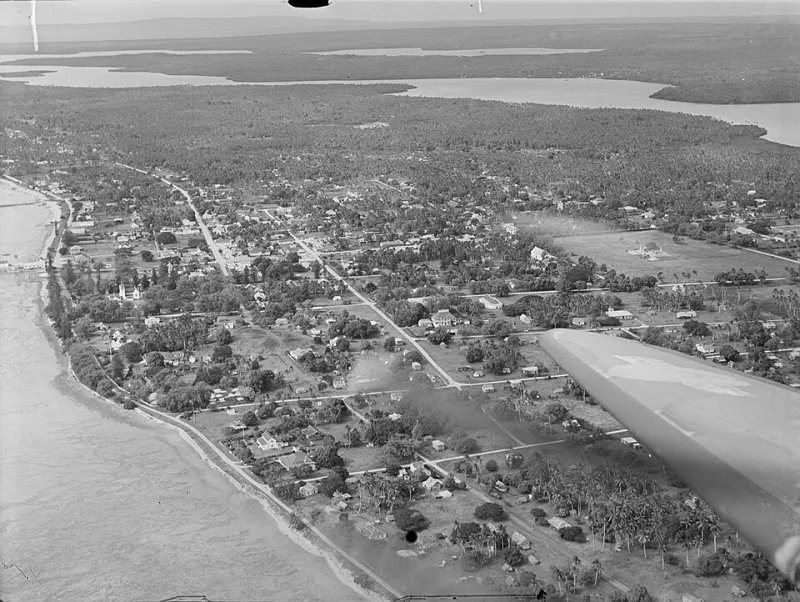
Photo: Collins, Tudor Washington, 1898-1970, photographer, CC BY 4.0, via Wikimedia Commons
You know the drill. A helicopter shot drifts over a city skyline. A wide frame of a dusty football field at golden hour. A sad beige office park with a sign that reads DUNDER MIFFLIN. Before a single character opens their mouth, you already know what kind of show you're watching, how much money everyone makes, and roughly whether you're supposed to laugh.
That's the establishing shot doing its job — and doing it better than most dialogue ever will.
The Cheapest Exposition in Television
Screenwriting gurus love to say "show, don't tell," but establishing shots are the purest version of that advice. Three seconds of a gleaming Manhattan tower with a logo on it tells you: wealth, power, corporate America, take this seriously. Three seconds of a strip mall nail salon between a payday loan place tells you the exact opposite. Nobody had to say a word.
It's also the genre's most honest narrator. Characters lie. Voiceovers editorialize. But the building? The building has no agenda. When Succession opens on Waystar Royco's glass headquarters looming over the skyline, the show isn't winking at you. It's just stating a fact: these people live above everyone else, literally.
Geography Is Characterization
Think about Friday Night Lights. The show could have opened every episode with a monologue about small-town Texas and the weight of expectation. Instead, it gave you wide shots of Dillon: flat horizons, water towers, empty streets, that stadium glowing like a cathedral in the distance. The landscape is the thesis. In a town with nothing else, football is the only building with lights on.
The Office went the other direction and got just as much out of it. The establishing shots of Scranton — the Steamtown Mall sign, the Pennsylvanian office park, the gray parking lots — are deliberately unglamorous. They're telling you this is a show about people who didn't leave. That's the whole emotional engine of the series, communicated via B-roll.
Even sitcoms that supposedly exist nowhere do this. The Friends apartment building, the Seinfeld diner, the How I Met Your Mother booth — these exteriors are so burned into our brains that fans make pilgrimages to them. The establishing shot graduated from exposition to landmark.
The Class Reveal
Here's the sneakier function: establishing shots are television's most reliable class indicator, and almost nobody talks about it.
Watch for it in your next binge. Prestige dramas about the wealthy get glass, steel, and aerial photography. Shows about working-class life get wide, ground-level shots of houses with vinyl siding, cars older than the characters, chain-link fences. Breaking Bad used Albuquerque's sprawl so effectively that the city became a character — those cracked desert vistas and beige subdivisions telling you exactly what kind of desperation we're dealing with before Walt ever puts on a hat.
Compare that to the cold opens of a show like The Morning Show or Billions, where the establishing shots are practically real estate porn. The camera lingers. The architecture is aspirational. Your brain registers the difference instantly, even if you never consciously notice it.
When the Shot Becomes a Punchline
Comedy figured out long ago that the establishing shot has a second gear: the ironic one. Parks and Recreation lovingly photographs Pawnee's government building and the Sunflower Diner like they're civic treasures, which is part of the joke — Leslie Knope's sincere patriotism reframes boring municipal architecture as beautiful. Schitt's Creek makes the town's sad motel and rose-tinted storefronts progressively warmer as the characters actually fall in love with the place. The establishing shots evolve with the emotional arc.
That's the tell, really. When a show cares about its establishing shots — when they're shot with intent rather than grabbed from a stock library — you can usually trust the show underneath.
Start Watching the Walls
The next time you press play, resist the skip-intro reflex for ten seconds and actually look at what the show shows you first. Is the camera above the city or on the ground? Is the light warm or institutional fluorescent? Is there a logo on the tallest building, and whose is it?
Production designers and location scouts are the unsung novelists of television. Their sentences are made of concrete and glass, and they write them before the actors ever arrive on set. The establishing shot isn't a formality. It's the opening paragraph — and most of us have been skimming it our whole lives.