Punchlines Without Words: What a Fight Scene Is Actually Saying
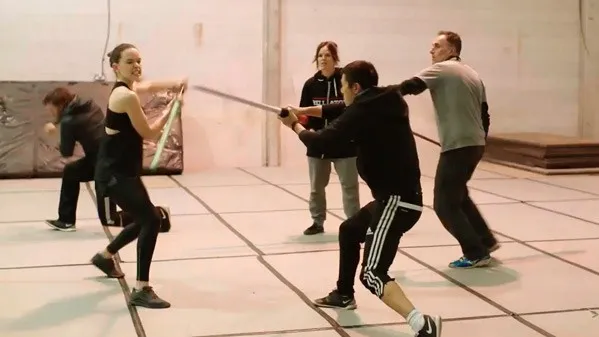
Photo: movie fight scene stunt choreography behind the scenes, via media.aintitcool.com
Watch the hallway fight in Oldboy long enough and you notice something strange: the hero gets tired. Not movie-tired, where the breathing gets heavy for one shot so the editor can cut away. Actually tired. He takes hits he can't dodge, leans on walls, nearly loses to a hallway full of guys who are, frankly, better at this than he is. By the time it's over, you know more about Oh Dae-su than any monologue could have told you.
That's the thing nobody says out loud about action cinema: a fight scene is a conversation. The fists are just grammar.
Choreography Is Characterization
Think about what a fight actually communicates before anyone throws a punch. How a character stands. Whether they check their corners. Whether they fight angry or fight scared. Whether they're protecting something or just trying to win.
Steven Soderbergh figured this out decades ago. Watch the bar fight in Haywire and notice how Michael Fassbender's character fights like a man who's been trained but not tested, while Gina Carano moves like someone who's done this for real and doesn't enjoy it. No line of dialogue in that movie tells you the power dynamic as clearly as the first thirty seconds of that brawl.
The best choreographers understand that audiences are fluent in this language even if they've never studied it. You can read a fight the way you read a face. You just might not know you're doing it.
The Shake-and-Bake Era, or: Panic as a Style
Around 2002, a German guy with a fear of stillness changed American action movies forever. The first Bourne film didn't invent shaky cam, but it weaponized it, and for about a decade afterward, every studio tried to replicate the feeling of a fight you can't quite follow.
Here's the controversial part: that incoherence was the point. Doug Liman and Paul Greengrass weren't hiding bad choreography (though sometimes they were). They were putting you inside Jason Bourne's adrenaline-drenched, dissociative skull. The camera panics because Bourne panics. The cuts come fast because his mind is moving fast. It's subjective filmmaking applied to a genre that had been almost purely objective for decades.
The problem is that everybody copied the technique without copying the intent. By 2010, you had movies shaking the camera at stunt doubles who were clearly not the lead actor, cutting every half-second, and hoping the blur covered the seams. The language of panic became the language of laziness.
Clarity Is the New Flex
Then came a stuntman named Chad Stahelski and his friend David Leitch, who had a radical idea: what if the audience could actually see the fight?
John Wick (2014) landed like a slap. Long takes. Wide lenses. The camera sits back and lets Keanu Reeves — who trained in judo, jiu-jitsu, and tactical shooting for months — actually do the thing. The choreography has a geometric logic to it: Wick moves through rooms like water finding the lowest point, and every opponent is an obstacle the space itself helps him solve.
And here's where the dialogue-as-fight metaphor really pays off. Wick doesn't talk much. He says maybe 400 words in the first movie. The fights ARE his dialogue. When he dispatches three guys in a nightclub bathroom, the movie is telling you about his grief, his precision, his inability to stop. The action isn't between the character beats. It IS the character beat.
The John Wick sequels pushed this further — the glass ballroom fight, the staircase that never ends, the duel with proper Old World formality. Each one is a paragraph in an ongoing argument about whether Wick can ever actually leave the table.
Everything, Everywhere, All at Once, Including the Kitchen
Which brings us to the weirdest and maybe best case study of the last decade. Everything Everywhere All at Once (2022) took fight choreography and made it genuinely philosophical — and hilariously domestic.
The fanny pack fight. The battle with security guards wielding sex toys. The bagel that threatens to consume the universe. Daniel Kwan and Daniel Scheinert understood that Evelyn Wang doesn't fight like John Wick because she isn't a trained assassin. She fights like a middle-aged woman who runs a laundromat and is drowning in tax paperwork. Her weaponized fanny pack isn't a joke (okay, it's partly a joke) — it's characterization. She fights with whatever's in reach because that's how she's survived her whole life.
And the film's emotional thesis lands in a fight scene. When Evelyn finally learns to fight like Joy rather than against her — absorbing rather than striking, choosing kindness inside the chaos — the choreography literally changes grammar. It stops being about winning.
How to Read a Fight Like a Book
So what should you actually watch for the next time two people on screen start swinging?
Watch the feet. Trained fighters move differently than untrained ones, and good movies know it. If a character's footwork is deliberate and economical, the film is telling you they've done this before.
Count the cuts. If a single punch takes eight edits to show, somebody's probably hiding something. If the camera holds, the filmmakers are confident in what they built.
Notice who gets hurt. Invincible heroes are boring on purpose sometimes, but a protagonist who bleeds in the second act is a protagonist the film is taking seriously.
Listen to the silence. The best fight scenes know when to drop the music. Sound design — the crunch, the gasp, the ringing after a hit — tells you how real this is supposed to feel.
The Point of It All
There's a temptation to treat action movies as the junk food of cinema — fun, loud, nutritionally empty. But the fight scene is one of the oldest storytelling tools humans have. We've been staging combats to reveal character since the first Greek tragedy put a sword fight offstage and had a messenger describe it.
The difference between a great action movie and a forgettable one usually isn't the budget or the explosions. It's whether the fights are saying something. Bourne's chaos said I don't know who I am. Wick's clarity said I know exactly who I am, and I wish I didn't. Evelyn's improvised chaos said I've been fighting my whole life and nobody ever taught me the rules.*
Two people throwing each other through a window can be pure spectacle. Or it can be the most honest conversation in the whole movie. The trick is learning to listen with your eyes.