Painted Skies, Real Feelings: What Cartoon Backgrounds Taught You About Mood Before You Could Read
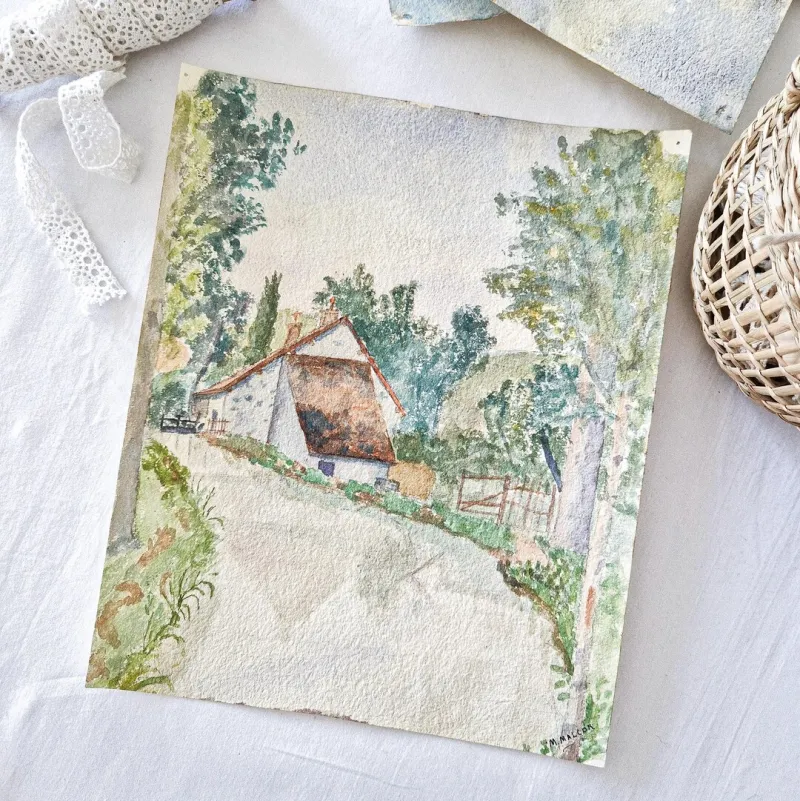
Photo: vintage hand-painted animation background art watercolor landscape, via i.etsystatic.com
Go back and watch an episode of DuckTales or Sailor Moon or Gargoyles — really watch it, the way you watched it at seven years old, flat on the carpet with a bowl of cereal — and something strange happens. The characters move. The plot happens. But the thing your eye keeps snagging on, the thing you couldn't name at seven and can't stop noticing at thirty-seven, is the sky.
Those painted skies. Those moody watercolor skylines. Those impossibly detailed alleys and living rooms and moonlit rooftops that flashed by in four-second cuts while Bugs Bunny did something ridiculous in the foreground.
We've spent decades treating cartoon backgrounds as set dressing. They're not. They're the reason an entire generation of American viewers developed a feel for mood — an instinctive, pre-verbal understanding of what a lonely color palette means, what dusk does to a city, why a room painted in warm ochres feels safe and one painted in cold teals doesn't. You learned cinematography from people holding paintbrushes.
The Invisible Professor
Here's the dirty secret of animation history: the background painters were often the most technically skilled artists in the entire studio. Animation is built on economy — characters are simplified, movement is cheat, frames are reused. Backgrounds got none of those shortcuts. A single painted setup for a Saturday morning show could take days, because it had to hold up under the scrutiny of kids who would watch the same episode four times before lunch.
And because backgrounds were static, they became the emotional anchor of every shot. When the animators needed a scene to feel a certain way — dread, wonder, small-town comfort — they couldn't do it with a performance, because a cartoon character's performance is limited by the budget of the frame count. So they did it with the paint behind the character. A purple-gray wash over a suburban street says 'something is wrong here' faster than any dialogue could.
You absorbed that grammar before you could tie your shoes. That's not an exaggeration — it's the entire premise of how visual literacy works. Children's media is the first cinema anyone sees, and its backgrounds are the first lighting diagrams anyone reads.
The Xerox Grit and the Watercolor Dream
Not all backgrounds taught the same lesson. The late '60s and '70s xerox era — that scratchy, high-contrast look born from studios photocopying pencil drawings directly onto cels to slash budgets — accidentally invented a whole aesthetic of urban unease. Those hard-edged, ink-heavy backdrops look, in retrospect, like graphic novels pretending to be children's television. Watch anything from that era and notice how the backgrounds do the menacing the characters can't.
Then there's the other lineage: the soft, luminous, anime-influenced watercolor work that flooded American TV in the late '80s and '90s. Shows importing stylistic DNA from Japanese productions — which themselves drew from a tradition of landscape painting as emotional expression — handed American kids their first lessons in atmospheric perspective. A distant mountain fading into haze isn't just depth; it's longing. Nobody told you that. You just felt it.
The Quote You Never Noticed
Now look at what the adults raised on this stuff are making.
The warm-golden-hour interiors of early Pixar — the lamp-lit rooms of Toy Story, the honeyed light of Up's opening — aren't inventing a visual language. They're speaking one that background painters spent fifty years perfecting. The muted, green-gray institutional palettes that signal 'this is a serious drama' in prestige TV? Learned behavior. Even the A24 title card — that quiet serif font floating over an empty landscape — is doing the exact job a painted establishing shot did in 1987: telling your nervous system how to feel before anyone speaks.
Once you see it, you can't unsee it. Modern shows quote these backgrounds constantly, frame-for-frame in spirit if not in line. That neon-lit rain-soaked street in your favorite streaming thriller? Your brain has a file for it, and the file is labeled with a cartoon you watched at age six.
Give the Painters Their Flowers
There's a reason animation fans get genuinely emotional talking about artists like Walt Peregoy or the unsung painters at studios across Tokyo and Burbank: these were people solving the hardest problem in visual storytelling — how to make a flat surface produce an emotion — with no dialogue, no performance, and usually no credit.
So here's a low-effort homework assignment with a high payoff. Pull up a cartoon from your childhood tonight. Ignore the characters entirely. Just watch the backgrounds for eleven minutes. Notice how the palette shifts when the plot needs you to worry. Notice how the sky is doing more narrative work than the villain.
Then ask yourself where you learned to read a frame that way.
You already know the answer. It was painted, and you were seven.